
Credentialing Without Delays. Enrollment Without Revenue Loss.

Simplify medical credentialing and provider enrollment with Admiria Health. From provider onboarding and insurance enrollment to CAQH management, Medicare, Medicaid, re-credentialing, and compliance monitoring - we keep your providers active, compliant, and revenue-ready.

Schedule Consultation
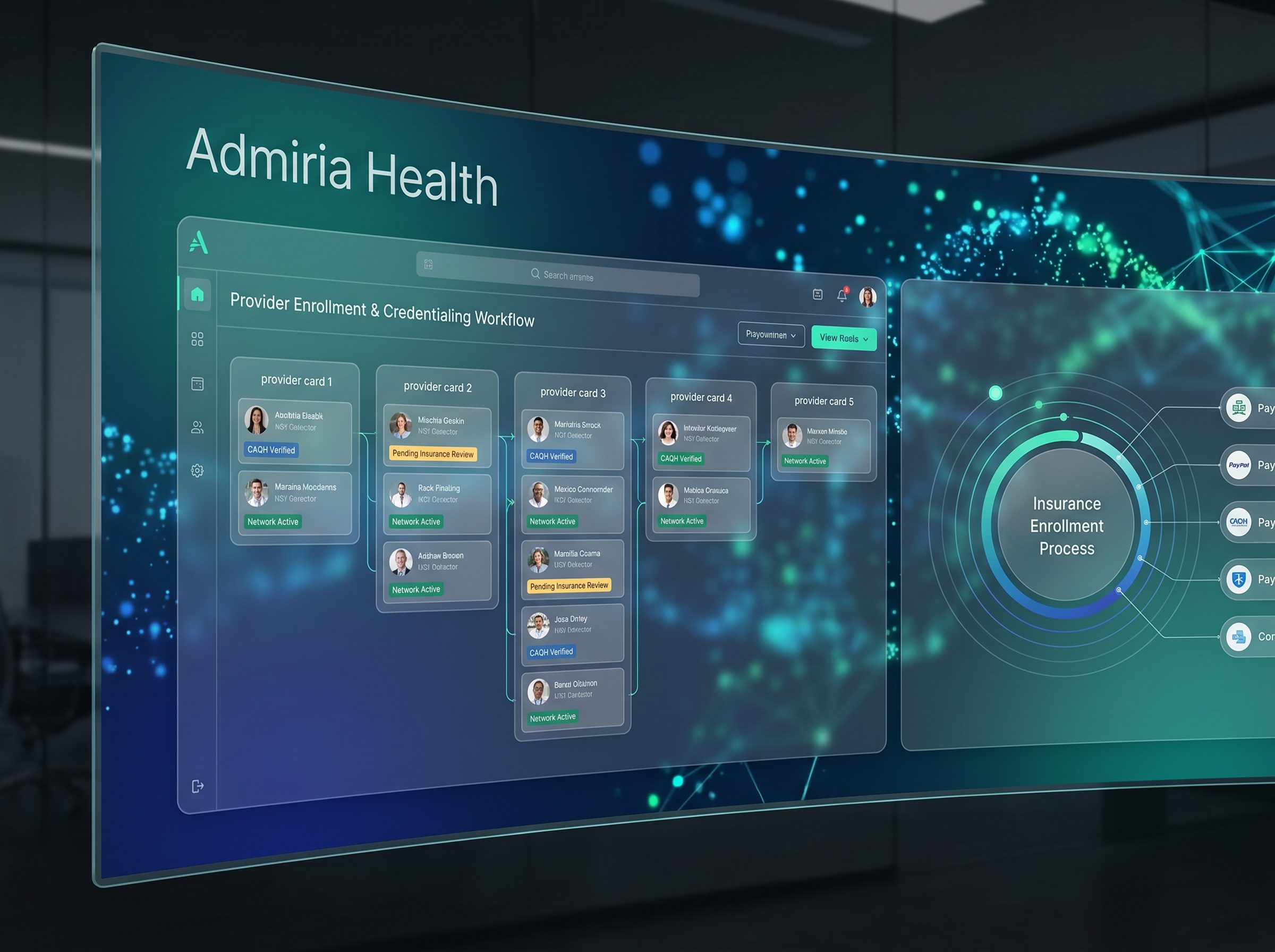

Commercial Insurance Plans Medicare Enrollment Medicaid Enrollment CAQH Management Multi-Specialty Support Provider Enrollment Specialists
Credentialing Compliance Dashboard
Provider Profile Verified
Enrollment Submitted
CAQH Attested
Active Status Confirmed
Verified
Approved
โœ“
Credentialing Services
Revenue at Risk

Credentialing Delays Can Delay Revenue

In healthcare operations, delayed credentialing directly impacts provider activation and revenue flow. When payer enrollment or CAQH updates are not completed on time, practices experience immediate financial and operational disruption.

See Our Process

Our Medical Credentialing & Provider Enrollment Workflow

Admiria Health follows a structured, end-to-end medical credentialing and provider enrollment workflow designed to eliminate delays, reduce administrative errors, and ensure continuous provider activation across all insurance networks. Our process integrates credentialing, CAQH management, payer enrollment, and compliance monitoring into a single streamlined system.

01

Provider Information Collection

Secure onboarding of provider data, including demographics, licenses, NPI, DEA, and practice details.

Incomplete data is the #1 cause of credentialing delays
02

Document Verification

Validation of all credentialing documents including certifications, malpractice insurance, and state licenses.

Expired documents trigger automatic rejections from payers
03

Payer Enrollment Submission

Submission of applications to commercial insurance, Medicare, and Medicaid payer networks.

Each payer has unique forms โ€” one error delays everything
04

CAQH Setup & Attestation

Creation and maintenance of CAQH profiles with continuous updates and attestation management.

CAQH attestation lapses cause immediate enrollment suspension
05

Insurance Follow-Up & Tracking

Direct communication with payers to track enrollment status and resolve delays or rejections.

60% of enrollments stall without proactive follow-up
06

Approval Monitoring

Real-time tracking of credentialing approvals, rejections, and pending status updates.

Knowing status early lets you fix issues before revenue stops
07

Provider Activation

Once approved, providers are activated across payer networks and made billing-ready.

Activation = revenue. Every day delayed is revenue lost
08

Continuous Credential Monitoring

Ongoing monitoring of license expirations, re-credentialing cycles, and compliance requirements.

Re-credentialing lapses can deactivate providers without warning
โ†’

Ready to Streamline?

Let Admiria Health handle your credentialing workflow end-to-end.

Get Started

Complete Physician Credentialing & Compliance Solutions

Our end-to-end physician credentialing and compliance services are designed to simplify healthcare administration, accelerate provider activation, and maintain continuous compliance across commercial insurance networks, Medicare, Medicaid, and specialty payer systems.

Provider Onboarding

  • Provider data collection
  • Document verification
  • Provider profile setup

Insurance Enrollment

  • Commercial insurance enrollment
  • Medicare & Medicaid enrollment
  • Specialty enrollment

Credential Maintenance

  • License monitoring
  • Renewals & re-credentialing
  • Expiry alerts

Credentialing Infrastructure Platform

A centralized healthcare workflow ecosystem connecting onboarding, payer enrollment, credential maintenance, CAQH management, compliance, and provider activation.

System Active

CAQH Management

  • CAQH setup & profile updates
  • Attestations management
  • Data monitoring

Compliance Management

  • Audit readiness
  • Documentation monitoring
  • Regulatory oversight

Group Linking & Setup

  • TIN linking & facility mapping
  • Taxonomy alignment
  • Location setup

Behind Every Active Provider Is A Dedicated Credentialing Team

Our credentialing specialists, enrollment coordinators, and compliance teams work through a structured provider enrollment workflow designed to reduce delays, maintain payer communication, and ensure continuous provider readiness across healthcare networks.

LIVE OPERATIONS COMMAND
System Online
Credentialing Queue
Provider Verification
94%
Enrollment Tracking Active
CAQH Updates Running
Compliance Monitoring Synced
Specialist Activity Stream
Credentialing Specialists
Enrollment Coordinators
CAQH Managers
Compliance Experts
Payer Communication Specialists
Database Management Team

Credentialing Specialists

Active
  • provider documentation review
  • credential verification
  • onboarding management
Verifying provider credentials...

Enrollment Coordinators

Processing
  • insurance enrollment submission
  • payer application handling
  • enrollment tracking
Enrollment status synchronized...

CAQH Managers

Monitoring
  • profile setup
  • maintenance
  • attestations
CAQH profile validation in progress...

Compliance Experts

Protected
  • regulatory monitoring
  • documentation auditing
  • renewal management
Compliance checks running...

Payer Communication Specialists

Connected
  • follow-ups
  • escalation management
  • approval tracking
Payer response updates received...

Database Management Team

Synced
  • demographic updates
  • roster management
  • provider database accuracy
Provider data synchronized...

Supporting Healthcare Specialties Across Multiple Care Models

Family Medicine โ€ข Internal Medicine โ€ข Cardiology โ€ข Dermatology โ€ข Orthopedics โ€ข Behavioral Health โ€ข Urgent Care โ€ข Physical Therapy โ€ข Optometry โ€ข Ophthalmology โ€ข Pain Management โ€ข Mental Health โ€ข Pediatrics โ€ข Dental โ€ข Multi-Specialty Groups โ€ข Family Medicine โ€ข Internal Medicine โ€ข Cardiology โ€ข Dermatology โ€ข Orthopedics โ€ข Behavioral Health โ€ข Urgent Care โ€ข Physical Therapy โ€ข Optometry โ€ข Ophthalmology โ€ข Pain Management โ€ข Mental Health โ€ข Pediatrics โ€ข Dental โ€ข Multi-Specialty Groups โ€ข

Transform Credentialing Bottlenecks Into Scalable Provider Operations

Healthcare practices often lose valuable time and revenue due to credentialing delays, incomplete documentation, and inefficient payer communication. Admiria Health replaces fragmented processes with a structured provider enrollment and credentialing system designed for continuous provider readiness.

Healthcare Friction
Operational Growth
Without Admiria

Fragmented Credentialing Workflow

Delayed enrollments
Revenue interruptions
Documentation errors
Expired licenses
Slow payer communication
Disconnected Nodes โ†’ Manual Delays โ†’ Revenue Impact
Operational Transformation
โ‡„
With Admiria

Credentialing Infrastructure Platform

Faster enrollment tracking
Continuous compliance
Active provider monitoring
Reduced administrative burden
Structured credential maintenance
Connected Workflow โ†’ Continuous Monitoring โ†’ Provider Activation

Frequently Asked Questions

Find answers to common provider enrollment, medical credentialing, CAQH, Medicare, Medicaid, and healthcare compliance questions healthcare practices frequently search for.

Medical credentialing services verify a healthcare provider's qualifications, including licenses, education, training, work history, and malpractice coverage, to ensure they meet insurance and regulatory standards required to treat patients and receive reimbursement.
Provider credentialing typically takes 30 to 120 days depending on the insurance payer, provider specialty, completeness of documentation, and responsiveness of the credentialing process.
Physician credentialing is required because insurance companies must verify that a provider is qualified and approved to deliver care before they can legally reimburse claims.
Common documents include medical licenses, DEA certificate, board certifications, malpractice insurance, NPI number, CV with work history, identification documents, and CAQH profile information.
Provider enrollment directly affects revenue because billing cannot begin until the provider is fully enrolled and active with insurance payers. Delays in enrollment result in delayed or lost reimbursements.
Delays are commonly caused by incomplete documentation, expired licenses, incorrect CAQH data, slow payer response times, missing application details, and high payer processing volumes.
Credentialing verifies a provider's qualifications, while provider enrollment is the process of applying and getting approved with insurance payers to start billing and receiving reimbursements.
CAQH profile management involves creating, updating, and regularly attesting provider information in the CAQH database so insurance companies can access accurate credentialing data for enrollment and re-credentialing.
Most insurance payers require re-credentialing every 2 to 3 years to ensure providers remain compliant with updated licensing, certifications, and regulatory requirements.
Yes, credentialing delays can significantly impact cash flow because providers cannot bill insurance companies until enrollment is active, leading to delayed or lost revenue.
Medicare provider enrollment is the process of registering a healthcare provider with the Medicare program so they can treat Medicare patients and receive reimbursement for services. The Centers for Medicare & Medicaid Services (CMS) manages enrollment through the Provider Enrollment, Chain, and Ownership System (PECOS).
Medicaid revalidation is a periodic process where providers must re-verify their information and credentials to remain active within the Medicaid program.
Yes, healthcare practices can outsource credentialing services to specialized companies to manage enrollment, CAQH updates, payer communication, and compliance tracking more efficiently.
Medicare enrollment typically takes 60 to 90 days, depending on application accuracy, provider type, and CMS processing timelines.
Commercial payer enrollment usually takes between 30 and 120 days depending on the insurance company and completeness of the application.
If a provider's license expires, insurance payers may deactivate the provider, suspend reimbursements, and require re-credentialing before reactivation.
Payer enrollment denials are reviewed to identify missing or incorrect information, corrected, and resubmitted with proper documentation and follow-up communication with the payer.
Group provider linking connects individual providers to a healthcare group or Tax Identification Number (TIN) so they can bill under the group's contracts and agreements with payers.
Proper credentialing ensures providers are correctly enrolled and active with insurance networks, reducing claim rejections due to eligibility, enrollment, or data mismatch issues.
All medical specialties require credentialing, including family medicine, internal medicine, cardiology, dermatology, orthopedics, behavioral health, pediatrics, and multi-specialty groups.
Yes, credentialing services are designed to support multi-specialty practices by managing multiple provider types, payer networks, and enrollment requirements simultaneously.
CAQH attestations are maintained by regularly updating provider information and confirming its accuracy every 120 days as required by most insurance payers.
Accurate provider data ensures successful enrollment, prevents claim denials, avoids delays in credentialing, and maintains compliance with insurance payer requirements.
Credentialing specialists communicate with payers through follow-ups, application tracking systems, email correspondence, portal submissions, and escalation processes when delays occur.
Healthcare practices can improve efficiency by maintaining updated documentation, using structured credentialing workflows, monitoring CAQH regularly, and outsourcing credentialing to specialized teams.
HIPAA compliance ensures that all provider documentation, personal information, and credentialing data are handled securely throughout the enrollment process. The U.S. Department of Health and Human Services oversees HIPAA regulations to protect patient privacy and data security in healthcare operations.

Why Practices Trust Admiria Health

Expertise
Compliance Focus
Continuous Monitoring
Dedicated Specialists
Transparent Communication
Scalable Workflows

Keep Providers Active. Keep Revenue Moving.

Simplify credentialing, accelerate enrollment, and maintain provider compliance with Admiria Health.

Get Started Today